
TranzOcean

Peak Season, Peak Pressure: How Smart Exporters Plan Their Cashew Shipments Months in Advance

Susila L Blog

Ask any experienced cashew exporter in Guinea-Bissau what separates a profitable season from a stressful one, and the answer is almost always the same: planning. Not the planning that happens when cargo is already sitting in the warehouse. The planning that starts months before the first bag of cashew is weighed.

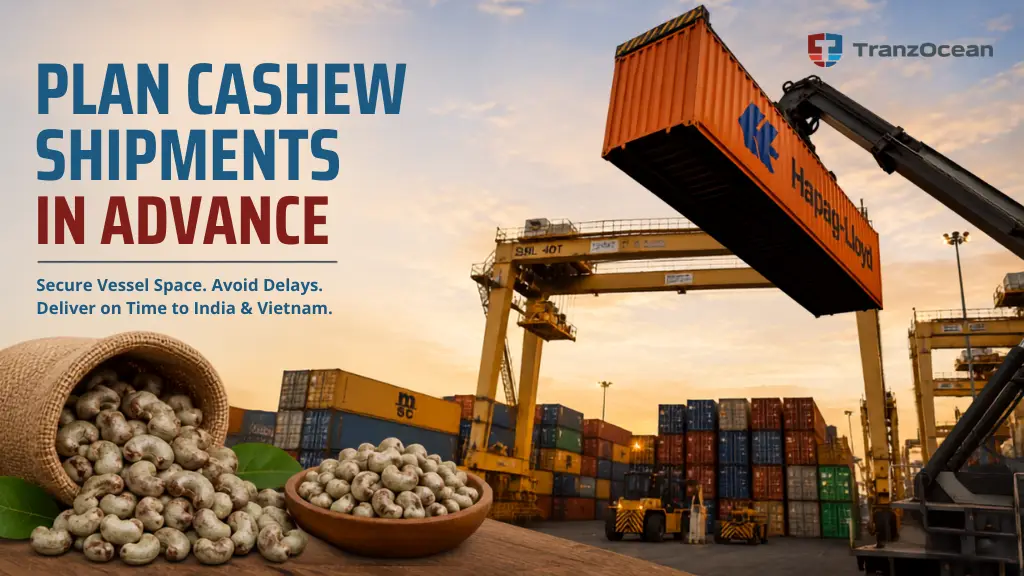
Guinea-Bissau’s cashew export season is one of the most compressed agricultural trade cycles in the world. Nearly 300,000 tons of raw cashew must move to markets in India and Vietnam within a window of just three to four months. In that environment, the exporters who plan their cashew shipments in advance are the ones who consistently deliver on time, protect their cargo quality, and build the kind of buyer relationships that last beyond a single season.

This guide explains exactly how they do it — and how any exporter can apply the same approach.

Why Peak Season Creates Peak Pressure

The mechanics of pressure during Guinea-Bissau’s cashew export season are straightforward. Supply is concentrated. Demand for vessel space is high. Port capacity is limited. And the clock is always running.

When thousands of tons of cashew are competing for the same limited berths, vessel slots, and container positions at the Port of Bissau, the exporters who move first consistently get better terms, better scheduling, and better outcomes. The ones who wait — for one more week of harvest, for a better price, for the cargo to be ready — often find themselves scrambling for whatever space is left at premium cost, with less time to move the cargo before quality begins to suffer.

The pressure of peak season is not just logistical. It is financial. Every week that raw cashew sits in a warehouse waiting for a vessel increases storage costs, increases quality risk from moisture and heat exposure, and increases the chance that the buyer at the other end starts looking at alternative supply options. In a trade where margins are tight and relationships are hard-earned, these costs add up fast.

Planning cashew shipments in advance does not eliminate peak season pressure — but it does ensure that pressure falls on the industry as a whole rather than specifically on your operation.

The Planning Calendar Smart Exporters Follow

4–6 Months Before Season — Market and Logistics Assessment

Smart exporters do not wait for the harvest to begin thinking about shipping. Four to six months before the season opens, they are already assessing the logistics landscape:

Which shipping partners are offering dedicated vessel services this season? What are the scheduled sailing dates? What capacity is available and at what price point?

This early-stage assessment has nothing to do with booking — it is about understanding the options well enough to make an informed decision when the time comes. Exporters who do this groundwork know exactly who to call when the season opens, rather than scrambling to find a partner when every other exporter in the country is doing the same thing.

2–3 Months Before Season — Buyer Commitments and Volume Confirmation

Two to three months before the export window opens, smart exporters are finalising their buyer commitments. How many tons have been contracted? To which markets — India, Vietnam, or both? Which destination ports are the buyers expecting delivery to?

These commitments drive the shipping decision. A confirmed buyer order in Tuticorin that requires delivery by a specific date works backward to a specific vessel departure from Bissau — which in turn defines exactly when cargo needs to be ready and which sailing the exporter must be on.

Exporters who plan cashew shipments in advance make their buyer commitments and their vessel bookings together, not separately. The two decisions are inseparable.

6–8 Weeks Before Loading — Vessel Booking Confirmation

This is the most critical window in the planning calendar. Six to eight weeks before the intended loading date, smart exporters confirm their vessel booking.

At this stage, they know their volume, their buyer destination, and their required delivery window. They approach their chosen shipping partner — one they assessed months earlier — and confirm space on the relevant sailing.

Waiting until this point, rather than booking earlier, is not procrastination. It is deliberate timing. Early enough to secure space before the peak rush fills the vessel, late enough to have firm cargo volumes and buyer commitments to book against.

3–4 Weeks Before Loading — Documentation and Container Preparation

With the vessel booking confirmed, the next phase of planning begins: documentation.

Phytosanitary certificates, quality inspection arrangements, export customs declarations, and bill of lading instructions all need to be prepared, checked, and ready before the vessel arrives. Documentation errors are one of the most common and most avoidable causes of shipment delay — and they are entirely preventable with enough lead time.

For exporters using the Full Container Service, this is also the window when container positioning at Bissau Port is coordinated. Containers must be available at the right location before stuffing begins, and confirming this early removes a common source of last-minute logistical chaos.

1–2 Weeks Before Loading — Final Cargo Preparation and Port Coordination

In the final week or two before loading, smart exporters focus on execution: ensuring cargo is properly bagged, weighed, and positioned for loading; confirming the tidal window schedule with the vessel operator; and coordinating inland transport from warehouse to port to align with the loading schedule.

This final stage should be calm and organised. If it feels frantic, it is almost always because something in the earlier planning stages was left too late.

The Cost of Not Planning in Advance

The difference in outcomes between exporters who plan cashew shipments in advance and those who react to the season as it unfolds is measurable and significant.

Vessel space cost: Exporters who book late often pay higher freight rates for whatever remaining space is available, or accept less favourable routing with longer transit times.

Quality loss: Cargo that waits weeks for a vessel loses moisture content and quality grade. At destination, this translates to lower outturn rates, quality claims, and price deductions that erode the margin on the entire shipment.

Buyer relationship damage: Buyers who receive late shipments adjust their procurement strategy for the following season. Exporters who consistently deliver on time earn preferred supplier status and the pricing power that comes with it.

Storage costs: Warehouse costs accumulate daily. A two-week delay in vessel departure can add meaningfully to the total cost of a shipment, reducing net realisation even if the cargo eventually moves at the original freight rate.

None of these costs appear in a single invoice. They compound quietly across the season, and their full impact often only becomes visible when the season’s books are closed.

How TranzOcean Line Supports Advance Planning

TranzOcean line publishes its seasonal vessel schedule for Guinea-Bissau well in advance of the export window opening, giving exporters exactly the fixed reference point they need to plan their cashew shipments in advance

Hagrid operates on confirmed seasonal voyages from Guinea-Bissau to Dakar, with onward mainline connections via Hapag Lloyd to Tuticorin, Cochin, Mangalore, Visakhapatnam, and Ho Chi Minh City. Each voyage has a published ETA at Bissau — a date exporters can build their entire pre-season planning calendar around.

Container positioning, documentation support, tidal scheduling, and transshipment coordination at Dakar are all managed by TranzOcean’s operations team, removing the logistical complexity that catches unprepared exporters off guard at peak season.

Start Planning Now — Before the Season Catches Up With You

The cashew season in Guinea-

The exporters who will move their cashew smoothly this season are not the ones who react the fastest when pressure peaks. They are the ones who are already planning now, while there is still time to make the right decisions without the pressure of a closing window.

If your operation sources or exports raw cashew from Guinea-Bissau, reach out to TranzOcean Line today. Our team will walk you through the seasonal vessel schedule, advise on the best service option for your volume and destination, and help you build a shipment plan that puts you ahead of the peak — not behind it.

Contact TranzOcean:

Email: cs@tranzocean.com
Phone: +245-957-995-262
Phone: +971-426-525-62
WhatsApp: +971-54-533-5545
 

Ask any experienced cashew exporter in Guinea-Bissau what separates a profitable season from a stressful one, and the answer is almost always the same: planning. Not the planning that happens when cargo is already sitting in the warehouse. The planning that starts months before the first bag of cashew is weighed.

Guinea-Bissau’s cashew export season is one of the most compressed agricultural trade cycles in the world. Nearly 300,000 tons of raw cashew must move to markets in India and Vietnam within a window of just three to four months. In that environment, the exporters who plan their cashew shipments in advance are the ones who consistently deliver on time, protect their cargo quality, and build the kind of buyer relationships that last beyond a single season.

This guide explains exactly how they do it — and how any exporter can apply the same approach.

Why Peak Season Creates Peak Pressure

The mechanics of pressure during Guinea-Bissau’s cashew export season are straightforward. Supply is concentrated. Demand for vessel space is high. Port capacity is limited. And the clock is always running.

When thousands of tons of cashew are competing for the same limited berths, vessel slots, and container positions at the Port of Bissau, the exporters who move first consistently get better terms, better scheduling, and better outcomes. The ones who wait — for one more week of harvest, for a better price, for the cargo to be ready — often find themselves scrambling for whatever space is left at premium cost, with less time to move the cargo before quality begins to suffer.

The pressure of peak season is not just logistical. It is financial. Every week that raw cashew sits in a warehouse waiting for a vessel increases storage costs, increases quality risk from moisture and heat exposure, and increases the chance that the buyer at the other end starts looking at alternative supply options. In a trade where margins are tight and relationships are hard-earned, these costs add up fast.

Planning cashew shipments in advance does not eliminate peak season pressure — but it does ensure that pressure falls on the industry as a whole rather than specifically on your operation.

The Planning Calendar Smart Exporters Follow

4–6 Months Before Season — Market and Logistics Assessment

Smart exporters do not wait for the harvest to begin thinking about shipping. Four to six months before the season opens, they are already assessing the logistics landscape:

Which shipping partners are offering dedicated vessel services this season? What are the scheduled sailing dates? What capacity is available and at what price point?

This early-stage assessment has nothing to do with booking — it is about understanding the options well enough to make an informed decision when the time comes. Exporters who do this groundwork know exactly who to call when the season opens, rather than scrambling to find a partner when every other exporter in the country is doing the same thing.

2–3 Months Before Season — Buyer Commitments and Volume Confirmation

Two to three months before the export window opens, smart exporters are finalising their buyer commitments. How many tons have been contracted? To which markets — India, Vietnam, or both? Which destination ports are the buyers expecting delivery to?

These commitments drive the shipping decision. A confirmed buyer order in Tuticorin that requires delivery by a specific date works backward to a specific vessel departure from Bissau — which in turn defines exactly when cargo needs to be ready and which sailing the exporter must be on.

Exporters who plan cashew shipments in advance make their buyer commitments and their vessel bookings together, not separately. The two decisions are inseparable.

6–8 Weeks Before Loading — Vessel Booking Confirmation

This is the most critical window in the planning calendar. Six to eight weeks before the intended loading date, smart exporters confirm their vessel booking.

At this stage, they know their volume, their buyer destination, and their required delivery window. They approach their chosen shipping partner — one they assessed months earlier — and confirm space on the relevant sailing.

Waiting until this point, rather than booking earlier, is not procrastination. It is deliberate timing. Early enough to secure space before the peak rush fills the vessel, late enough to have firm cargo volumes and buyer commitments to book against.

3–4 Weeks Before Loading — Documentation and Container Preparation

With the vessel booking confirmed, the next phase of planning begins: documentation.

Phytosanitary certificates, quality inspection arrangements, export customs declarations, and bill of lading instructions all need to be prepared, checked, and ready before the vessel arrives. Documentation errors are one of the most common and most avoidable causes of shipment delay — and they are entirely preventable with enough lead time.

For exporters using the Full Container Service, this is also the window when container positioning at Bissau Port is coordinated. Containers must be available at the right location before stuffing begins, and confirming this early removes a common source of last-minute logistical chaos.

1–2 Weeks Before Loading — Final Cargo Preparation and Port Coordination

In the final week or two before loading, smart exporters focus on execution: ensuring cargo is properly bagged, weighed, and positioned for loading; confirming the tidal window schedule with the vessel operator; and coordinating inland transport from warehouse to port to align with the loading schedule.

This final stage should be calm and organised. If it feels frantic, it is almost always because something in the earlier planning stages was left too late.

The Cost of Not Planning in Advance

The difference in outcomes between exporters who plan cashew shipments in advance and those who react to the season as it unfolds is measurable and significant.

Vessel space cost: Exporters who book late often pay higher freight rates for whatever remaining space is available, or accept less favourable routing with longer transit times.

Quality loss: Cargo that waits weeks for a vessel loses moisture content and quality grade. At destination, this translates to lower outturn rates, quality claims, and price deductions that erode the margin on the entire shipment.

Buyer relationship damage: Buyers who receive late shipments adjust their procurement strategy for the following season. Exporters who consistently deliver on time earn preferred supplier status and the pricing power that comes with it.

Storage costs: Warehouse costs accumulate daily. A two-week delay in vessel departure can add meaningfully to the total cost of a shipment, reducing net realisation even if the cargo eventually moves at the original freight rate.

None of these costs appear in a single invoice. They compound quietly across the season, and their full impact often only becomes visible when the season’s books are closed.

How TranzOcean Line Supports Advance Planning

TranzOcean line publishes its seasonal vessel schedule for Guinea-Bissau well in advance of the export window opening, giving exporters exactly the fixed reference point they need to plan their cashew shipments in advance

Hagrid operates on confirmed seasonal voyages from Guinea-Bissau to Dakar, with onward mainline connections via Hapag Lloyd to Tuticorin, Cochin, Mangalore, Visakhapatnam, and Ho Chi Minh City. Each voyage has a published ETA at Bissau — a date exporters can build their entire pre-season planning calendar around.

Container positioning, documentation support, tidal scheduling, and transshipment coordination at Dakar are all managed by TranzOcean’s operations team, removing the logistical complexity that catches unprepared exporters off guard at peak season.

Start Planning Now — Before the Season Catches Up With You

The cashew season in Guinea-

The exporters who will move their cashew smoothly this season are not the ones who react the fastest when pressure peaks. They are the ones who are already planning now, while there is still time to make the right decisions without the pressure of a closing window.

If your operation sources or exports raw cashew from Guinea-Bissau, reach out to TranzOcean Line today. Our team will walk you through the seasonal vessel schedule, advise on the best service option for your volume and destination, and help you build a shipment plan that puts you ahead of the peak — not behind it.

Contact TranzOcean:

Email: cs@tranzocean.com
Phone: +245-957-995-262
Phone: +971-426-525-62
WhatsApp: +971-54-533-5545
 

Leave a Reply

Your email address will not be published. Required fields are marked *