
Every year, the same story plays out across Guinea-Bissau. The cashew harvest arrives. Warehouses fill up. Buyers in India and Vietnam are waiting. And exporters — experienced and new alike — face the same critical question: where do I find a reliable vessel to move my cargo before the season closes?
Finding a vessel for raw cashew export from Guinea-Bissau is not as simple as making a phone call. It involves understanding the port, knowing the right shipping options, and acting early enough to actually secure space. This guide covers everything an exporter in Guinea-Bissau needs to know — from understanding the port constraints to choosing the right service and booking before it is too late.
Why Vietnamese Factories Source Raw Cashew from Guinea-Bissau
Guinea-Bissau exports close to 300,000 tons of raw cashew annually — but almost all of that volume must move within a window of just three to four months. That extreme concentration of export activity within such a short period creates intense competition for vessel space every single season.
The Port of Bissau adds its own layer of complexity. As a river port, it operates under draft restrictions that prevent large ocean-going mainline vessels from calling directly. This means exporters cannot simply book space on a standard container shipping line the way they might from a major deep-water port. Cargo must first move on a feeder vessel from Bissau to a transshipment hub — most commonly Dakar in Senegal — before connecting to mainline services bound for India or Vietnam.
Tidal windows further complicate operations. Vessel berthing and loading at Bissau are governed by tidal conditions, which means available loading time is limited and precise coordination is essential. Miss the window and the vessel departs without your cargo.
Finally, berth availability at peak season is genuinely scarce. When hundreds of exporters are all trying to move cargo at the same time through the same constrained port, vessel space disappears fast — often faster than exporters expect.
Understanding Your Shipping Options from Guinea-Bissau
Before searching for a vessel, every exporter needs to understand the two main service models available for raw cashew export from Guinea-Bissau.
Option 1 — Full Container Service
In this model, empty shipping containers are positioned at Bissau Port ahead of the sailing date. Exporters stuff their raw cashew — either at their own warehouse or at the port — and the sealed containers are transported by feeder vessel to Dakar, where they connect to a mainline service for final delivery to India or Vietnam.
This option offers the highest level of cargo protection. The cashew is sealed at origin and travels under that seal all the way to the destination port. Documentation is cleaner, customs clearance at destination is faster, and quality dispute risk is significantly lower. For exporters supplying buyers who require seal integrity from origin, this is the preferred choice.
Option 2 — Bulk-to-Container Transshipment
In this model, bagged raw cashew is loaded in bulk onto a feeder vessel at Bissau Port and transported to Dakar. At Dakar, the cargo is discharged and professionally stuffed into shipping line containers for mainline connection to India or Vietnam.
This approach suits exporters moving larger volumes or those whose operational setup makes warehouse stuffing at Bissau impractical. It reduces pressure on the constrained port infrastructure at Bissau during peak season and allows higher throughput per vessel call.
How to Find a Reliable Vessel for Raw Cashew Export from Guinea-Bissau
Step 1 — Start Looking Before You Think You Need To
The single most common mistake exporters make when searching for a vessel for raw cashew export from Guinea-Bissau is starting too late. By the time cargo is physically ready and sitting in a warehouse, the best vessel slots — especially on dedicated, scheduled services — are often already committed.
Start the conversation with shipping partners at least four to six weeks before your intended loading date. This gives enough time to confirm space, arrange container positioning if needed, and prepare documentation without rushing.
Step 2 — Choose a Dedicated Service Over a Spot Booking
The spot market — booking whatever vessel space happens to be available at the moment cargo is ready — is the highest-risk approach during peak cashew season. Spot availability is unpredictable, pricing is volatile, and the vessel that was available last week may be fully committed by the time your cargo is ready.
A dedicated, scheduled service operates on fixed sailing dates published in advance. This means exporters can plan their entire operation — harvest aggregation, warehouse stuffing, documentation, inland transport — around a confirmed vessel arrival date rather than an uncertain one.
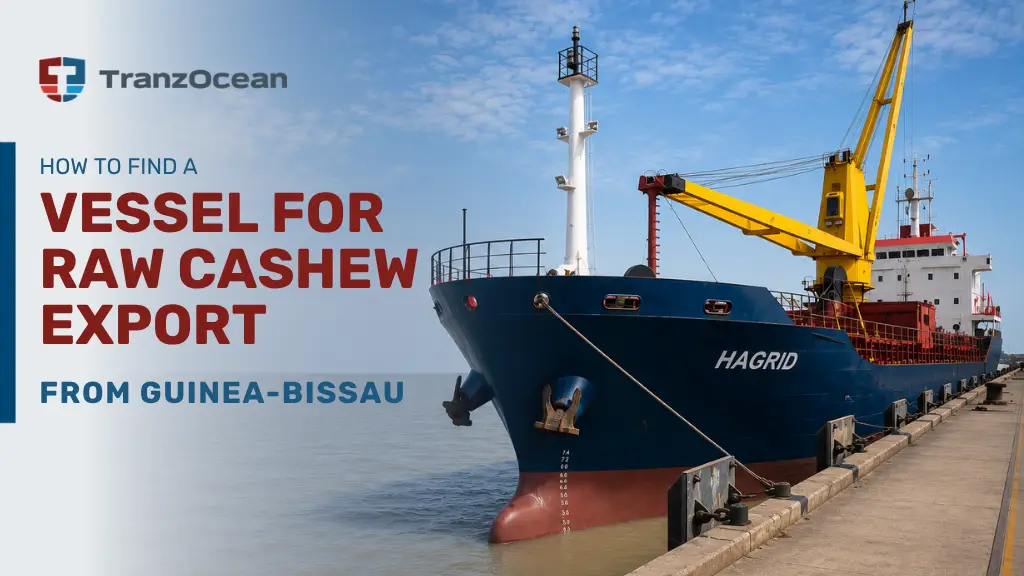
Dedicated services like TranzOcean’s MV. Hagrid operate on fixed seasonal schedules from Guinea-Bissau, giving exporters the planning certainty the spot market cannot provide.
Step 3 — Verify the Operator's Guinea-Bissau Experience
Not every shipping company that claims to serve West Africa has genuine operational experience at the Port of Bissau. The tidal scheduling, the draft constraints, the documentation processes, and the local agent network all require specific on-the-ground knowledge that only comes from actually operating at this port.
When evaluating a shipping partner for raw cashew export from Guinea-Bissau, ask directly about their operational history at Bissau. How many seasons have they operated this corridor? What is their process for managing tidal windows? Who are their local agents at the port?
A company that cannot answer these questions clearly has probably not done this before at scale — and the peak cashew season is not the time to find out.
Step 4 — Understand the Full Route, Not Just the First Leg
Exporters sometimes focus only on getting cargo out of Bissau without fully planning the onward journey. But the connection from Dakar to the final destination — India or Vietnam — is equally important. Transit time, mainline vessel frequency, and destination port options all affect when your buyer receives the cargo.
When booking a vessel for raw cashew export from Guinea-Bissau, confirm the full end-to-end route including the Dakar transshipment timeline and the mainline connection to your buyer’s destination port: Tuticorin, Cochin, Mangalore, Visakhapatnam, or Ho Chi Minh City.
Step 5 — Prepare Documentation Early
Export documentation for raw cashew from Guinea-Bissau includes phytosanitary certificates, quality certificates, bills of lading, and customs export declarations. These documents take time to process correctly, and errors in documentation are one of the most common causes of delay at both the origin port and the destination.
Start documentation preparation as soon as your vessel booking is confirmed — not the day before sailing. A shipping partner with experience on this corridor will guide you through the specific requirements for each destination market.
What to Look for in a Cashew Shipping Partner
The right shipping partner for raw cashew export from Guinea-Bissau is not necessarily the one with the lowest freight rate. In a time-sensitive, quality-sensitive trade, the factors that matter most are:
Dedicated seasonal vessels — not ad hoc spot capacity Fixed, published sailing schedules — so you can plan backward from a confirmed date Proven operational experience at Bissau Port — knowledge of tidal windows, draft conditions, and local procedures End-to-end route management — from Bissau through Dakar to Indian and Vietnamese ports Clean documentation support — reducing clearance delays at destination
TranzOcean’s dedicated vessel service for Guinea-Bissau raw cashew export covers all of these. MV. Hagrid operates on a fixed seasonal schedule from Bissau to Dakar, with onward connections to Tuticorin, Cochin, Mangalore, Visakhapatnam, and Ho Chi Minh City via Hapag Lloyd mainline services.
Secure Your Vessel Space Before the Season Closes
The cashew season in Guinea-Bissau does not wait, and neither does vessel space on a reliable, scheduled service. Exporters who plan ahead — understanding their options, choosing the right service model, and booking early — consistently move their cargo more smoothly, protect quality better, and deliver to their buyers on time.
If you are looking for a vessel for raw cashew export from Guinea-Bissau this season, contact TranzOcean Line now and let our team put together a shipping plan around your volume and schedule.
Contact TranzOcean:
Email: cs@tranzocean.com
Phone: +245-957-995-262
Phone: +971-426-525-62
WhatsApp: +971-54-533-5545