
TranzOcean

Guinea-Bissau to Cat Lai — Everything Vietnam’s Cashew Factories Need to Know About Shipping

Susila L Blog

Vietnam’s cashew processing industry runs on raw cashew imports. The country processes more cashew kernels than almost anywhere else in the world, and the factories driving that output — clustered around Ho Chi Minh City, Binh Duong, and Dong Nai — depend on a steady, timely supply of raw cashew from origins across West Africa, East Africa, and beyond.

Among those origins, Guinea-Bissau stands out. The country exports close to 300,000 tons of raw cashew annually, and a significant share of that volume is destined for Vietnamese processing factories. For procurement teams managing supply chains into Cat Lai Port, understanding the Guinea-Bissau to Cat Lai shipping route — how it works, what affects it, and how to secure space reliably — is essential knowledge for running a competitive cashew operation.

This guide covers everything Vietnamese cashew factories need to know about shipping raw cashew from Guinea-Bissau to Cat Lai.

Why Vietnamese Factories Source Raw Cashew from Guinea-Bissau

Vietnam does not produce enough raw cashew domestically to feed its own processing capacity. The country’s factories import the vast majority of their raw cashew, and West Africa — particularly Guinea-Bissau — is one of the most important supply regions.

Guinea-Bissau cashew is valued by Vietnamese processors for specific, practical reasons. Outturn rates — the weight of kernel recovered per ton of raw cashew — are consistently strong, which directly affects processing margins. The cashew is typically harvested and handled within a concentrated seasonal window, which, when logistics are managed properly, means it arrives at Cat Lai in good condition. And the volume available from Guinea-Bissau — approaching 300,000 tons annually — gives Vietnamese buyers a meaningful sourcing scale without depending on a single smaller-volume origin.

For factories in Binh Duong and Dong Nai that run continuous processing lines, Guinea-Bissau represents a reliable, large-volume input that fits naturally into their procurement strategy. The challenge is not finding the cashew — it is getting it from Bissau to Cat Lai efficiently, on a schedule that keeps the factory floor running.

Understanding the Guinea-Bissau to Cat Lai Route

The Guinea-Bissau to Cat Lai shipping route is not a single direct voyage. It is a multi-leg journey that requires careful coordination across two distinct shipping phases.
Phase 1 — Bissau to Dakar (Feeder Leg)

The Port of Bissau operates as a river port with significant physical constraints. Draft restrictions prevent large ocean-going mainline vessels from calling directly, meaning cargo must first be moved on a smaller feeder vessel from Bissau to a deep-water transshipment hub.

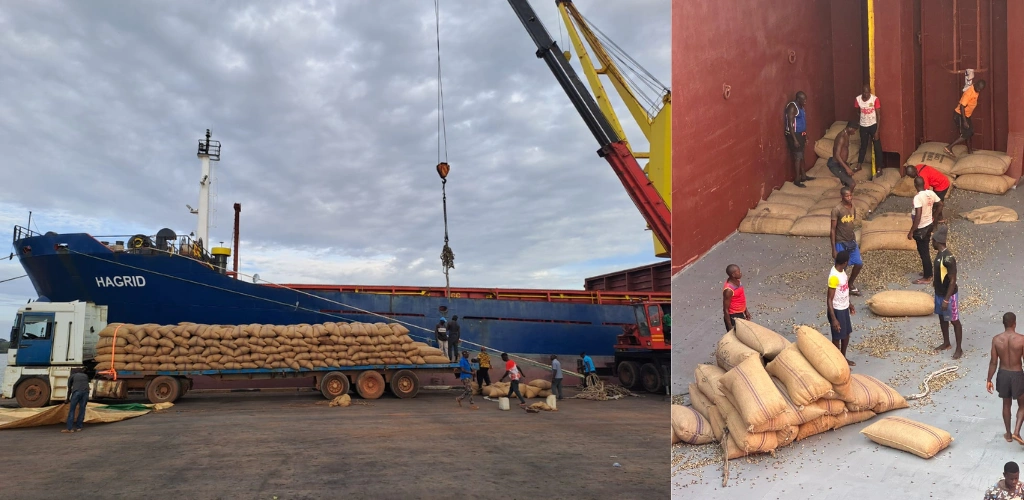
TranzOcean Line operates this feeder leg using MV. Hagrid, a dedicated bulk cargo vessel with a capacity of 3,200 to 3,600 metric tons, sailing on a fixed seasonal schedule. The feeder voyage connects Bissau Port to Dakar, Senegal — a fully equipped deep-water port with direct mainline vessel connections to Ho Chi Minh City.

This feeder leg is the most operationally complex part of the Guinea-Bissau to Cat Lai route. Tidal windows govern berthing and loading at Bissau. Berth availability during peak season is limited. And the compressed three to four month export window means every voyage matters. Working with a shipping partner who has built operations specifically around this leg — rather than one treating it as an afterthought — makes a measurable difference to how smoothly cargo moves.

Phase 2 — Dakar to Cat Lai (Mainline Connection)

At Dakar, cargo connects to a mainline container vessel service bound for Ho Chi Minh City. TranzOcean Line coordinates the transshipment at Dakar and the onward mainline connection, ensuring Vietnamese buyers receive a seamless journey from origin to Cat Lai without having to manage multiple shipping providers for different legs.

Transit time from Dakar to Cat Lai via mainline connection is typically 18 to 25 days depending on the specific vessel and routing. Combined with the feeder leg from Bissau, Vietnamese factories should plan their procurement calendars with the full end-to-end journey time in mind.

Two Cargo Options for Vietnamese Factories

Not all Vietnamese cashew processors move cargo in the same way. TranzOcean Line offers two service options for the Guinea-Bissau to Cat Lai route, designed to suit different operational preferences.

Full Container Service — Origin-Sealed, Cat Lai-Ready

TranzOcean Line positions empty containers at Bissau Port ahead of each seasonal voyage, collected from hub ports like Dakar or Abidjan. Exporters in Guinea-Bissau stuff the cashew at their own warehouse or at the port, and the sealed containers move under TranzOcean Line custody from Bissau through Dakar to Cat Lai.

For Vietnamese factories, this means cashew arrives at Cat Lai with an intact original seal from Guinea-Bissau, clean bill of lading documentation, and phytosanitary certificates aligned with Vietnamese import requirements. The sealed container approach minimises quality risk during transit and reduces the likelihood of documentation complications at customs clearance in Ho Chi Minh City — a particularly important consideration given how tightly Vietnamese import regulations are enforced.

Bulk-to-Container Transshipment — Maximum Volume, Dakar Efficiency

For Vietnamese buyers sourcing larger volumes or working with Guinean exporters who prefer traditional bagged cargo movement, TranzOcean Line bulk-to-container transshipment model provides a high-throughput alternative.

Bagged cashew is loaded in bulk onto MV. Hagrid at Bissau and transported to Dakar. At Dakar, TranzOcean Line operations team discharges the bulk cargo and professionally stuffs it into shipping line containers for mainline connection to Cat Lai. This approach reduces pressure on Bissau Port during the peak season rush, allows higher volumes to move per voyage, and connects to the competitive mainline freight economics available from Dakar.

What Vietnamese Factories Need to Plan For

Successfully shipping raw cashew from Guinea-Bissau to Cat Lai requires Vietnamese procurement teams to plan further ahead than many currently do.

Book vessel space early. The Guinea-Bissau cashew export window runs for just three to four months. During this window, vessel space on dedicated, scheduled services fills quickly. Vietnamese factories that wait until cargo is physically ready before confirming their shipping arrangement often find themselves competing for limited remaining space at higher cost — or facing delays that disrupt their production schedules.

Align procurement with the vessel schedule. TranzOcean publishes its seasonal voyage schedule well in advance of the export window opening. Vietnamese buyers should align their purchase contracts with exporters to the confirmed ETA at Bissau for each voyage, ensuring cargo is ready to load within the tidal and operational window available at port.

Account for full end-to-end transit time. The Guinea-Bissau to Cat Lai journey involves a feeder leg, transshipment at Dakar, and a mainline voyage to Ho Chi Minh City. Vietnamese factories should build realistic end-to-end transit time into their production planning — rather than working backward only from the Cat Lai arrival date — to avoid factory floor shortfalls during the cashew processing season.

Why TranzOcean Line Is the Right Partner for Guinea-Bissau to Cat Lai Shipping

Vietnamese cashew factories choosing a logistics partner for Guinea-Bissau to Cat Lai shipments need more than a vessel — they need a team that understands every stage of this specific route.

TranzOcean Line operations are built around the Bissau corridor. The team manages tidal scheduling at Bissau, container positioning, documentation alignment with Vietnamese import requirements, Dakar transshipment, and mainline connection to Cat Lai — all under one point of contact. For Vietnamese buyers, this means a single accountable partner across the full journey rather than separate providers at each leg who share responsibility for delays without owning them.

The 2026 cashew season is already underway. Voyage schedules are confirmed, and cargo space is filling.

Contact TranzOcean:

Email: cs@tranzocean.com
Phone: +245-957-995-262
Phone: +971-426-525-62
WhatsApp: +971-54-533-5545
 

Vietnam’s cashew processing industry runs on raw cashew imports. The country processes more cashew kernels than almost anywhere else in the world, and the factories driving that output — clustered around Ho Chi Minh City, Binh Duong, and Dong Nai — depend on a steady, timely supply of raw cashew from origins across West Africa, East Africa, and beyond.

Among those origins, Guinea-Bissau stands out. The country exports close to 300,000 tons of raw cashew annually, and a significant share of that volume is destined for Vietnamese processing factories. For procurement teams managing supply chains into Cat Lai Port, understanding the Guinea-Bissau to Cat Lai shipping route — how it works, what affects it, and how to secure space reliably — is essential knowledge for running a competitive cashew operation.

This guide covers everything Vietnamese cashew factories need to know about shipping raw cashew from Guinea-Bissau to Cat Lai.

Why Vietnamese Factories Source Raw Cashew from Guinea-Bissau

Vietnam does not produce enough raw cashew domestically to feed its own processing capacity. The country’s factories import the vast majority of their raw cashew, and West Africa — particularly Guinea-Bissau — is one of the most important supply regions.

Guinea-Bissau cashew is valued by Vietnamese processors for specific, practical reasons. Outturn rates — the weight of kernel recovered per ton of raw cashew — are consistently strong, which directly affects processing margins. The cashew is typically harvested and handled within a concentrated seasonal window, which, when logistics are managed properly, means it arrives at Cat Lai in good condition. And the volume available from Guinea-Bissau — approaching 300,000 tons annually — gives Vietnamese buyers a meaningful sourcing scale without depending on a single smaller-volume origin.

For factories in Binh Duong and Dong Nai that run continuous processing lines, Guinea-Bissau represents a reliable, large-volume input that fits naturally into their procurement strategy. The challenge is not finding the cashew — it is getting it from Bissau to Cat Lai efficiently, on a schedule that keeps the factory floor running.

Understanding the Guinea-Bissau to Cat Lai Route

The Guinea-Bissau to Cat Lai shipping route is not a single direct voyage. It is a multi-leg journey that requires careful coordination across two distinct shipping phases.

Phase 1 — Bissau to Dakar (Feeder Leg)

The Port of Bissau operates as a river port with significant physical constraints. Draft restrictions prevent large ocean-going mainline vessels from calling directly, meaning cargo must first be moved on a smaller feeder vessel from Bissau to a deep-water transshipment hub.

TranzOcean Line operates this feeder leg using MV. Hagrid, a dedicated bulk cargo vessel with a capacity of 3,200 to 3,600 metric tons, sailing on a fixed seasonal schedule. The feeder voyage connects Bissau Port to Dakar, Senegal — a fully equipped deep-water port with direct mainline vessel connections to Ho Chi Minh City.

This feeder leg is the most operationally complex part of the Guinea-Bissau to Cat Lai route. Tidal windows govern berthing and loading at Bissau. Berth availability during peak season is limited. And the compressed three to four month export window means every voyage matters. Working with a shipping partner who has built operations specifically around this leg — rather than one treating it as an afterthought — makes a measurable difference to how smoothly cargo moves.

Phase 2 — Dakar to Cat Lai (Mainline Connection)

At Dakar, cargo connects to a mainline container vessel service bound for Ho Chi Minh City. TranzOcean Line coordinates the transshipment at Dakar and the onward mainline connection, ensuring Vietnamese buyers receive a seamless journey from origin to Cat Lai without having to manage multiple shipping providers for different legs.

Transit time from Dakar to Cat Lai via mainline connection is typically 18 to 25 days depending on the specific vessel and routing. Combined with the feeder leg from Bissau, Vietnamese factories should plan their procurement calendars with the full end-to-end journey time in mind.

Two Cargo Options for Vietnamese Factories

Not all Vietnamese cashew processors move cargo in the same way. TranzOcean Line offers two service options for the Guinea-Bissau to Cat Lai route, designed to suit different operational preferences.

Full Container Service — Origin-Sealed, Cat Lai-Ready

TranzOcean Line positions empty containers at Bissau Port ahead of each seasonal voyage, collected from hub ports like Dakar or Abidjan. Exporters in Guinea-Bissau stuff the cashew at their own warehouse or at the port, and the sealed containers move under TranzOcean Line custody from Bissau through Dakar to Cat Lai.

For Vietnamese factories, this means cashew arrives at Cat Lai with an intact original seal from Guinea-Bissau, clean bill of lading documentation, and phytosanitary certificates aligned with Vietnamese import requirements. The sealed container approach minimises quality risk during transit and reduces the likelihood of documentation complications at customs clearance in Ho Chi Minh City — a particularly important consideration given how tightly Vietnamese import regulations are enforced.

Bulk-to-Container Transshipment — Maximum Volume, Dakar Efficiency

For Vietnamese buyers sourcing larger volumes or working with Guinean exporters who prefer traditional bagged cargo movement, TranzOcean Line bulk-to-container transshipment model provides a high-throughput alternative.

Bagged cashew is loaded in bulk onto MV. Hagrid at Bissau and transported to Dakar. At Dakar, TranzOcean Line operations team discharges the bulk cargo and professionally stuffs it into shipping line containers for mainline connection to Cat Lai. This approach reduces pressure on Bissau Port during the peak season rush, allows higher volumes to move per voyage, and connects to the competitive mainline freight economics available from Dakar.

What Vietnamese Factories Need to Plan For

Successfully shipping raw cashew from Guinea-Bissau to Cat Lai requires Vietnamese procurement teams to plan further ahead than many currently do.

Book vessel space early. The Guinea-Bissau cashew export window runs for just three to four months. During this window, vessel space on dedicated, scheduled services fills quickly. Vietnamese factories that wait until cargo is physically ready before confirming their shipping arrangement often find themselves competing for limited remaining space at higher cost — or facing delays that disrupt their production schedules.

Align procurement with the vessel schedule. TranzOcean publishes its seasonal voyage schedule well in advance of the export window opening. Vietnamese buyers should align their purchase contracts with exporters to the confirmed ETA at Bissau for each voyage, ensuring cargo is ready to load within the tidal and operational window available at port.

Account for full end-to-end transit time. The Guinea-Bissau to Cat Lai journey involves a feeder leg, transshipment at Dakar, and a mainline voyage to Ho Chi Minh City. Vietnamese factories should build realistic end-to-end transit time into their production planning — rather than working backward only from the Cat Lai arrival date — to avoid factory floor shortfalls during the cashew processing season.

Why TranzOcean Line Is the Right Partner for Guinea-Bissau to Cat Lai Shipping

Vietnamese cashew factories choosing a logistics partner for Guinea-Bissau to Cat Lai shipments need more than a vessel — they need a team that understands every stage of this specific route.

TranzOcean Line operations are built around the Bissau corridor. The team manages tidal scheduling at Bissau, container positioning, documentation alignment with Vietnamese import requirements, Dakar transshipment, and mainline connection to Cat Lai — all under one point of contact. For Vietnamese buyers, this means a single accountable partner across the full journey rather than separate providers at each leg who share responsibility for delays without owning them.

The 2026 cashew season is already underway. Voyage schedules are confirmed, and cargo space is filling.

Contact TranzOcean:

Email: cs@tranzocean.com
Phone: +245-957-995-262
Phone: +971-426-525-62
WhatsApp: +971-54-533-5545
 

Leave a Reply

Your email address will not be published. Required fields are marked *