
TranzOcean

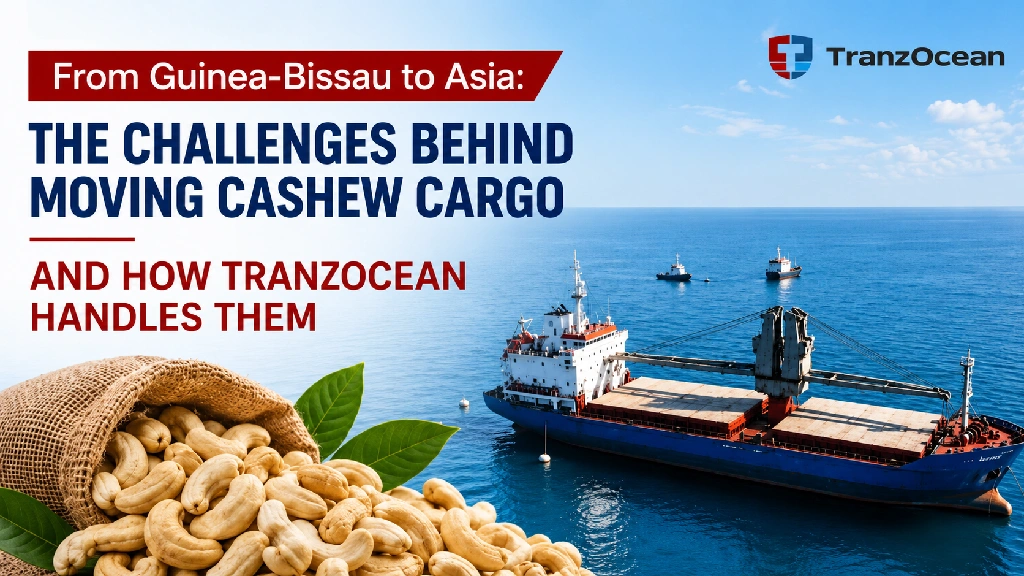
From Guinea-Bissau to Asia: The Challenges Behind Moving Cashew Cargo and How TranzOcean Handles Them

Susila L Container Shipping

The Crop That Carries a Country

For a few months each year, one crop plays a defining role in the movement of Guinea-Bissau’s economy: cashew. Often described as the backbone of the country’s economy, cashew is far more than an agricultural commodity. According to the IMF’s 2025 Article IV Consultation, raw cashew nuts account for more than 90% of Guinea-Bissau’s exports. The World Bank also highlights the crop’s importance to household livelihoods: data from its 2010 household survey showed that cashew accounted for 26% of income for female-headed households and 35% for male-headed households, making it an important source of monetary income, particularly for poorer households.

As the harvest season begins, the impact extends well beyond the farms. Farmers, traders, warehouses, ports, and vessels all move into action, working within the same seasonal window. And once the crop is harvested, another part of the journey begins — moving the raw cashew from Guinea-Bissau to major processing markets such as India and Vietnam.

But here’s the twist: almost none of that cashew is processed at home. It leaves Guinea-Bissau raw, bound for the world’s biggest processing markets — chiefly India, along with Vietnam — thousands of nautical miles away. Which means the real challenge isn’t growing the crop. It’s getting it there, intact and on time, before the window closes.

That’s the story behind every cashew shipment that leaves Guinea-Bissau. And on paper, it looks simple enough..

Guinea-Bissau → Dakar → India / Vietnam.

But behind those three locations is a much more complicated journey.

The route may look straightforward.

Making the journey work smoothly is not.

Our Guinea-Bissau cashew operation is built around moving raw cashew cargo in break bulk aboard Mv. Hagrid from Guinea-Bissau to Dakar, where the cargo moves into the next stage of its journey as containerized cargo bound for India and Vietnam.

Challenge 1: Moving Large Volumes:

Raw cashews are highly seasonal, creating massive operational pressure during export windows. Cargo preparation, vessel sizing, loading, and port operations must be tightly synchronized, a level of coordination standard container bookings cannot support. To handle this scale, TranzOcean deploys the Mv. Hagrid as a bulk carrier on the Guinea-Bissau to Dakar leg, moving raw cashew nuts in bulk rather than individual containers.

Challenge 2: Synchronizing Cargo and Voyage Timing:

Vessels run on fixed schedules, but agricultural supply chains do not. Cashew availability fluctuates based on harvest pacing, processing readiness, and weather delays. Consequently, vessel scheduling cannot happen in isolation—the voyage plan must align with actual cargo readiness, not just a target departure date. At the Port of Bissau, berthing availability can be an additional constraint.

Port and Operational Realities

 Vessels run on fixed schedules, but agricultural supply chains do not. Cashew availability fluctuates based on harvest pacing, processing readiness, and weather delays. Consequently, vessel scheduling cannot happen in isolation—the voyage plan must align with actual cargo readiness, not just a target departure date. At the Port of Bissau, berthing availability can be an additional constraint.

The port has two berthing faces with different capabilities. The main jetty is 260 metres long with a maximum alongside draft of 10 metres, while the small pier is 135 metres long with a maximum draft of 6.5 metres. With container vessels given priority at the main jetty, larger break bulk vessels can sometimes remain at anchor until the berth becomes available. This can result in extended waiting times before loading can begin.

For vessels up to 135 metres in length, loading may also involve a two-stage operation: initially loading at the small pier to a draft of around 6.2 metres before shifting to the main jetty to complete loading. While this allows cargo operations to continue while the deeper berth is occupied, the additional vessel movement adds time and coordination requirements to the port call.

These conditions mean that a vessel’s departure cannot be planned around a target date alone. Cargo readiness, weather, berth availability, vessel shifting, and loading progress all need to be considered together when planning the voyage. This is what makes synchronizing the cargo and vessel schedule a key challenge during the cashew season.

Challenge 3: Streamlining the Loading Process:

These operational realities make vessel availability one of the most important factors during the export season. As berthing windows become limited and demand for shipping capacity increases, securing reliable vessel space becomes increasingly competitive.

Without a dependable sailing schedule, exporters may face uncertainty over loading dates and shipment planning. Even a short delay can create a ripple effect throughout the supply chain, affecting documentation, warehouse planning, buyer expectations, and onward logistics.

For businesses supplying international markets, predictability is just as valuable as speed. Knowing when a vessel will arrive, secure a berth, and depart allows exporters to plan with confidence, fulfil contractual commitments, and manage their operations more efficiently.

The Dakar Hub: Connecting Bulk to Containers:

Dakar is the critical transfer point where break bulk cashews aboard Mv. Hagrid are containerized for onward transit to India and Vietnam. Unifying these two distinct transport modes under one seamless shipment prevents supply chain gaps like demurrage, extra handling fees, and documentation errors.

Post-Discharge Accountability:

Operational responsibility extends beyond Dakar. TranzOcean tracks voyage performance across every handling stage, leveraging post-voyage insights to continually optimize the corridor.

Proactive Exporter Communication:

Multi-stage shipping fails without visibility. TranzOcean eliminates client guesswork by providing real-time updates across key milestones—from loading and departure to Dakar processing and final containerization.

Aligned Documentation:

Physical cargo cannot outrun missing paperwork. Ensuring data accuracy, quantities, vessel manifests, and customs documentation across both shipping legs prevents costly customs holds and operational delays.

Built for the Cargo, Not Just the Route

Choosing a shipping partner is about more than securing vessel space. It is about working with a team that understands the trade, the operational realities, and the importance of delivering on every commitment.

With dedicated vessel services, experienced operational planning, and seamless connections from Bissau through Dakar to India and Vietnam, TranzOcean helps exporters move their cargo with greater reliability and confidence. Our focus is not simply on transporting containers—it is on supporting the long-term success of Guinea-Bissau’s cashew export industry.

Because the challenge isn’t simply moving cashew cargo.

It’s making the entire journey work.

Moving Cargo Is Only Part of the Journey

The Guinea-Bissau to Asia cashew corridor is more than a simple movement from one port to another. It requires careful coordination between seasonal cargo availability, the right type and size of ship, vessel operations, port handling, documentation, and the cargo and transshipment process at Dakar. At TranzOcean, we manage this complexity as one connected operation. From deploying Mv. Hagrid for the Guinea-Bissau–Dakar leg to coordinating the transshipment process at Dakar and supporting the onward movement of cargo to India and Vietnam, every stage is planned with the next one in mind. Because in a seasonal supply chain, successful transportation is not just about moving cargo. It is about making every part of the journey work together efficiently, reliably, and on time. That is where TranzOcean’s operational approach makes the difference.

Contact TranzOcean:

Email: cs@tranzocean.com
Phone: +245-957-995-262
WhatsApp: +971-54-533-5545 | +971-426-525-62
 

The Crop That Carries a Country

For a few months each year, one crop plays a defining role in the movement of Guinea-Bissau’s economy: cashew. Often described as the backbone of the country’s economy, cashew is far more than an agricultural commodity. According to the IMF’s 2025 Article IV Consultation, raw cashew nuts account for more than 90% of Guinea-Bissau’s exports. The World Bank also highlights the crop’s importance to household livelihoods: data from its 2010 household survey showed that cashew accounted for 26% of income for female-headed households and 35% for male-headed households, making it an important source of monetary income, particularly for poorer households.

As the harvest season begins, the impact extends well beyond the farms. Farmers, traders, warehouses, ports, and vessels all move into action, working within the same seasonal window. And once the crop is harvested, another part of the journey begins — moving the raw cashew from Guinea-Bissau to major processing markets such as India and Vietnam.

But here’s the twist: almost none of that cashew is processed at home. It leaves Guinea-Bissau raw, bound for the world’s biggest processing markets — chiefly India, along with Vietnam — thousands of nautical miles away. Which means the real challenge isn’t growing the crop. It’s getting it there, intact and on time, before the window closes.

That’s the story behind every cashew shipment that leaves Guinea-Bissau. And on paper, it looks simple enough..

Guinea-Bissau → Dakar → India / Vietnam.

But behind those three locations is a much more complicated journey.

The route may look straightforward.

Making the journey work smoothly is not.

Our Guinea-Bissau cashew operation is built around moving raw cashew cargo in break bulk aboard Mv. Hagrid from Guinea-Bissau to Dakar, where the cargo moves into the next stage of its journey as containerized cargo bound for India and Vietnam.

Challenge 1: Moving Large Volumes:

Raw cashews are highly seasonal, creating massive operational pressure during export windows. Cargo preparation, vessel sizing, loading, and port operations must be tightly synchronized, a level of coordination standard container bookings cannot support. To handle this scale, TranzOcean deploys the Mv. Hagrid as a bulk carrier on the Guinea-Bissau to Dakar leg, moving raw cashew nuts in bulk rather than individual containers.

Challenge 2: Synchronizing Cargo and Voyage Timing:

Vessels run on fixed schedules, but agricultural supply chains do not. Cashew availability fluctuates based on harvest pacing, processing readiness, and weather delays. Consequently, vessel scheduling cannot happen in isolation—the voyage plan must align with actual cargo readiness, not just a target departure date. At the Port of Bissau, berthing availability can be an additional constraint.

Port and Operational Realities

 Vessels run on fixed schedules, but agricultural supply chains do not. Cashew availability fluctuates based on harvest pacing, processing readiness, and weather delays. Consequently, vessel scheduling cannot happen in isolation—the voyage plan must align with actual cargo readiness, not just a target departure date. At the Port of Bissau, berthing availability can be an additional constraint.

The port has two berthing faces with different capabilities. The main jetty is 260 metres long with a maximum alongside draft of 10 metres, while the small pier is 135 metres long with a maximum draft of 6.5 metres. With container vessels given priority at the main jetty, larger break bulk vessels can sometimes remain at anchor until the berth becomes available. This can result in extended waiting times before loading can begin.

For vessels up to 135 metres in length, loading may also involve a two-stage operation: initially loading at the small pier to a draft of around 6.2 metres before shifting to the main jetty to complete loading. While this allows cargo operations to continue while the deeper berth is occupied, the additional vessel movement adds time and coordination requirements to the port call.

These conditions mean that a vessel’s departure cannot be planned around a target date alone. Cargo readiness, weather, berth availability, vessel shifting, and loading progress all need to be considered together when planning the voyage. This is what makes synchronizing the cargo and vessel schedule a key challenge during the cashew season.

Challenge 3: Streamlining the Loading Process:

These operational realities make vessel availability one of the most important factors during the export season. As berthing windows become limited and demand for shipping capacity increases, securing reliable vessel space becomes increasingly competitive.

Without a dependable sailing schedule, exporters may face uncertainty over loading dates and shipment planning. Even a short delay can create a ripple effect throughout the supply chain, affecting documentation, warehouse planning, buyer expectations, and onward logistics.

For businesses supplying international markets, predictability is just as valuable as speed. Knowing when a vessel will arrive, secure a berth, and depart allows exporters to plan with confidence, fulfil contractual commitments, and manage their operations more efficiently.

The Dakar Hub: Connecting Bulk to Containers:

Dakar is the critical transfer point where break bulk cashews aboard Mv. Hagrid are containerized for onward transit to India and Vietnam. Unifying these two distinct transport modes under one seamless shipment prevents supply chain gaps like demurrage, extra handling fees, and documentation errors.

Post-Discharge Accountability:

Operational responsibility extends beyond Dakar. TranzOcean tracks voyage performance across every handling stage, leveraging post-voyage insights to continually optimize the corridor.

Proactive Exporter Communication:

Multi-stage shipping fails without visibility. TranzOcean eliminates client guesswork by providing real-time updates across key milestones—from loading and departure to Dakar processing and final containerization.

Aligned Documentation:

Physical cargo cannot outrun missing paperwork. Ensuring data accuracy, quantities, vessel manifests, and customs documentation across both shipping legs prevents costly customs holds and operational delays.

Built for the Cargo, Not Just the Route

Choosing a shipping partner is about more than securing vessel space. It is about working with a team that understands the trade, the operational realities, and the importance of delivering on every commitment.

With dedicated vessel services, experienced operational planning, and seamless connections from Bissau through Dakar to India and Vietnam, TranzOcean helps exporters move their cargo with greater reliability and confidence. Our focus is not simply on transporting containers—it is on supporting the long-term success of Guinea-Bissau’s cashew export industry.

Because the challenge isn’t simply moving cashew cargo.

It’s making the entire journey work.

Moving Cargo Is Only Part of the Journey

The Guinea-Bissau to Asia cashew corridor is more than a simple movement from one port to another. It requires careful coordination between seasonal cargo availability, the right type and size of ship, vessel operations, port handling, documentation, and the cargo and transshipment process at Dakar. At TranzOcean, we manage this complexity as one connected operation. From deploying Mv. Hagrid for the Guinea-Bissau–Dakar leg to coordinating the transshipment process at Dakar and supporting the onward movement of cargo to India and Vietnam, every stage is planned with the next one in mind. Because in a seasonal supply chain, successful transportation is not just about moving cargo. It is about making every part of the journey work together efficiently, reliably, and on time. That is where TranzOcean’s operational approach makes the difference.

Contact TranzOcean:

Email: cs@tranzocean.com
Phone: +245-957-995-262
WhatsApp: +971-54-533-5545 | +971-426-525-62
 

Leave a Reply

Your email address will not be published. Required fields are marked *