
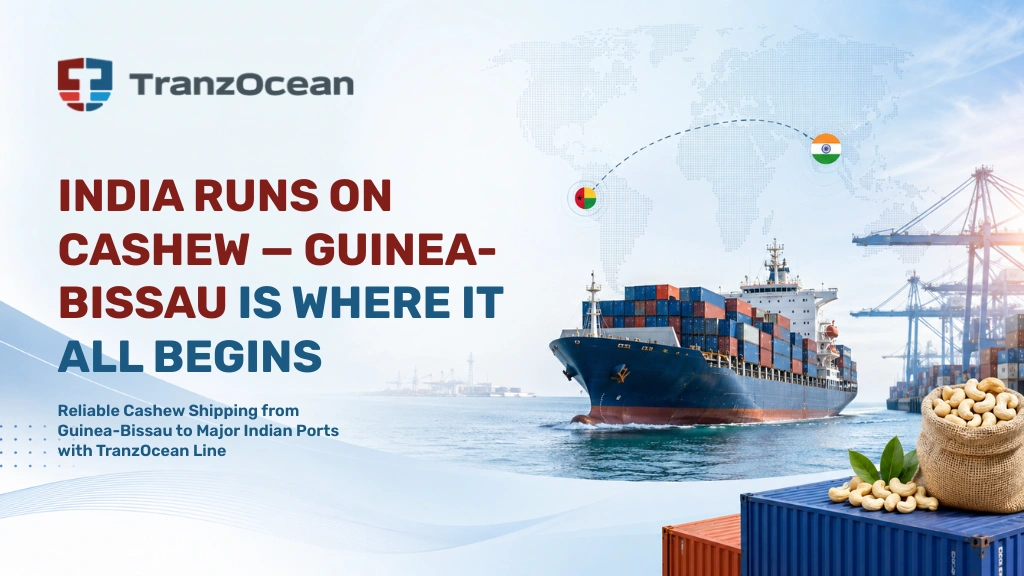
Why India’s four biggest cashew ports are watching West Africa closely this season — and how TranzOcean Line is connecting the two ends of this trade
Walk into any cashew processing facility in South India — in Tuticorin, Mangalore, Cochin, or Visakhapatnam — and you will find the same story playing out on the factory floor. Machines are running. Workers are sorting, grading, and packing. Containers of processed cashew kernels are being loaded for export to Europe, the United States, and the Middle East.
What keeps all of this running? Raw cashew from West Africa.
India is the world’s second-largest processor of cashew kernels, and a significant share of the raw cashew feeding Indian factories comes from one small country on the west coast of Africa — Guinea-Bissau. Without a steady, timely, well-managed supply from that origin, India’s cashew industry does not run at full capacity.
And without a reliable shipping partner connecting Bissau to Indian ports, that supply simply does not arrive on time.
That is the gap TranzOcean Line exists to close.
India's Cashew Industry: Powered by Imports
India’s cashew processing sector is vast. The country processes hundreds of thousands of tons of raw cashew annually and exports processed kernels worth billions of dollars. But India’s domestic cashew production — primarily from states like Kerala, Goa, Karnataka, and Andhra Pradesh — is not sufficient to meet factory demand.
The shortfall is made up entirely by imports. And West Africa, particularly Guinea-Bissau, is one of the most important sources.
Guinea-Bissau exports close to 300,000 tons of raw cashew annually, and a large portion of that cargo is destined for the processing belts of South and East India. Buyers in Tuticorin, Cochin, Mangalore, and Visakhapatnam source cashew from Guinea-Bissau, season after season because the quality is consistent, the outturn rates are competitive, and the pricing works for their processing economics.
But there is a complication that keeps procurement managers up at night: this entire supply must move in three to four months. The cashew harvest in Guinea-Bissau peaks once a year, and the export window is short. Miss the window, and the cargo either deteriorates in a warehouse or arrives at destination in worse condition than the buyer contracted for.
The pressure is intense — and it demands a shipping solution that is equally serious about timing.
The Four Indian Ports — and What Makes Each One Matter
TranzOcean Line 2026 service on MV. Hagrid calls at four major Indian ports, each serving a distinct processing and trading region. Understanding what makes each port important helps explain why TranzOcean Line multi-port call structure is so valuable for buyers across India.
Tuticorin — Tamil Nadu's Cashew Capital
V.O. Chidambaranar Port in Tuticorin (also known as Thoothukudi) is one of India’s premier cashew import gateways. The city has a long-established cashew processing industry, with factories that have been sourcing raw cashew from West Africa for decades.
Tuticorin’s processors are typically large-scale operators with international export clients. They need raw cashew to arrive on a schedule that aligns with their production runs and export commitments. A delay of even two or three weeks can push a processing cycle out of sequence, affecting kernel exports to Europe or the Gulf.
For Tuticorin buyers sourcing from Guinea-Bissau, TranzOcean Line fixed sailing schedule — four voyages between June and August — provides the planning certainty they need. Instead of chasing spot vessel space in a congested market, they know exactly when MV. Hagrid is arriving and can plan their production calendar accordingly.
Cochin — Kerala's Deep-Water Gateway
Kochi Port serves Kerala’s extensive cashew processing belt, which stretches from Kollam in the south through Kochi and beyond. Kerala has one of India’s oldest and most established cashew processing traditions, with hundreds of factories — from large industrial operations to smaller artisan processors — all dependent on imported raw cashew.
Cochin is a deep-water port with well-developed container and bulk handling infrastructure, making it well-suited to receive the type of cargo that TranzOcean Line moves from Guinea-Bissau. The port’s proximity to Kerala’s processing zones means shorter inland transport, lower logistics costs, and faster delivery from vessel to factory floor.
For Cochin buyers, TranzOcean Line service provides a direct supply line from one of the world’s best cashew-producing origins, with the reliability of a scheduled service rather than the uncertainty of a spot market.
Mangalore — The Karnataka Connection
New Mangalore Port is Karnataka’s primary deep-water gateway and an increasingly important cashew import hub. The port serves processors and traders across Karnataka and parts of Goa, and its location on the west coast makes it well-positioned for cargo arriving from West Africa via the Indian Ocean.
Mangalore’s cashew trade has grown steadily as Karnataka’s processing capacity has expanded. Buyers in the region source from multiple West African origins, but Guinea-Bissau’s quality profile makes it a preferred origin for buyers who supply premium markets.
TranzOcean Line call at Mangalore means Karnataka buyers can receive Guinea-Bissau raw cashew directly — without the additional transhipment or inland transport cost of routing cargo through a distant port.
Visakhapatnam — East India's Industrial Port
Visakhapatnam Port (Vizag) is the largest port on India’s east coast and serves as the gateway to Andhra Pradesh’s industrial and agricultural processing sectors. The cashew processing industry in the region has grown significantly over the past decade, with factories sourcing increasing volumes of raw cashew from West Africa.
Vizag’s port infrastructure is well-equipped for large-volume cargo handling, making it suitable for the type of bulk and containerized cashew shipments that TranzOcean Line moves from Guinea-Bissau. For processors in Andhra Pradesh and Telangana, receiving cargo at Vizag means shorter inland haul, lower trucking cost, and faster time from port to factory.
The inclusion of Visakhapatnam in TranzOcean Line 2026 call rotation means that East India buyers now have direct access to the Guinea-Bissau supply corridor — without having to route cargo around the subcontinent.
The Journey: How Cargo Moves from Bissau to Your Indian Factory
Understanding the route helps buyers plan better and appreciate the logistical precision that TranzOcean Line brings to this corridor.
Step 1 — Cargo Assembly at Bissau Exporters in Guinea-Bissau aggregate raw cashew — in bags either at their warehouses or at Bissau Port. TranzOcean Line coordinates with exporters on stuffing schedules, documentation, and port slot allocation well ahead of the sailing date.
Step 2 — Feeder Voyage: Bissau to Dakar MV. Hagrid loads cargo at Bissau Port and sails to Dakar, Senegal — a fully equipped deep-water hub with direct mainline vessel connections to India. This feeder leg efficiently moves cargo out of the capacity-constrained Port of Bissau and into the mainline shipping network.
Step 3 — Transshipment at Dakar At Dakar, cargo is either transferred directly as containers (for the All Container Service) or stuffed into shipping line containers from bulk bags (for the Bulk-to-Container service). TranzOcean Line operations team manages this process end-to-end, ensuring clean documentation handover and seamless connection to the mainline vessel.
Step 4 — Mainline Voyage to India The cargo connects to a mainline container service at Dakar, bound for Indian ports. Depending on the sailing connection, transit times from Dakar to Indian ports typically run 18 to 25 days, putting Guinea-Bissau cashew on Indian factory floors within the critical early-season window.
Step 5 — Port Delivery and Clearance Containers arrive at the Indian destination port — Tuticorin, Cochin, Mangalore, or Visakhapatnam. TranzOcean Line provides full documentation support to the buyer’s customs broker for clearance, and the cargo is released for inland delivery to the processing facility.
What Indian Buyers Gain with TranzOcean Line
For Indian cashew processors and traders sourcing from Guinea-Bissau, the choice of shipping partner has direct consequences for their business performance. TranzOcean Line’s service is designed to deliver advantages that go well beyond simply moving cargo from A to B.
Production planning certainty. With four confirmed voyages on a published schedule, buyers can set their factory calendars against known arrival dates. No more scrambling to reschedule production runs because a spot booking did not materialise.
Quality protection at origin. TranzOcean Line ensures that cashew is sealed at Bissau and arrives at Indian ports in the same condition it left Guinea-Bissau — critical for buyers who have contracted specific quality grades and cannot afford disputes at destination.
Documentation reliability. Clean bills of lading, complete phytosanitary certificates, and accurate cargo documentation reduce customs clearance time at Indian ports and minimise the risk of regulatory holds on arrival.
Direct port coverage. With calls at Tuticorin, Cochin, Mangalore, and Visakhapatnam, buyers receive cargo at their nearest port — reducing inland logistics cost and delivery time from port to factory.
A partner who understands the trade. The TranzOcean Line team is not learning the Guinea-Bissau cashew trade from scratch each season. They have built their operations around it — which means fewer surprises, faster problem resolution, and a more professional experience from booking to delivery.
Full route: Guinea-Bissau → Dakar (transshipment) → Ho Chi Minh City
The schedule is designed to match the rhythm of the cashew export season — early June through mid-August — when Guinea-Bissau’s harvest is at its freshest and Vietnamese factories are in peak procurement mode.
Booking for the 2026 Season
Secure Your Space Before the Season Fills
The 2026 cashew season is open and the Indian buyers who have placed orders with Guinea-Bissau exporters — or who are in the process of doing so — should confirm their shipping arrangements now, before the peak-season rush puts pressure on available vessel space.
The TranzOcean Line operations team is ready to discuss your volume requirements, advise on the most suitable service model, and confirm your cargo space on the relevant voyage.
Reach TranzOcean today:
📞 International / Landline: +245-957-995-262
📱 WhatsApp: +971-54-533-5545 | +971-426-525-62
✉️ Email: cs@TranzOcean Line.com
🌐 Website: www.TranzOcean Line.com